The 2023 International Labour Organization (ILO) youth survey revealed that in Tunisia and Egypt, 80% of youth aged 15-29 worked informally while youth inactivity reaches 17% in Spain and 25% in Türkiye (Education at a Glance 2023 report). The same report claims that for multiple reasons young Mediterranean women are much more vulnerable and affected by dropping out of school and precarious employment. International reports indicate that inadequate learning and skills are key factors contributing to high NEET (youth Not in Employment, Education or Training) rates. Most education systems in the Middle East and North Africa (MENA) region do not focus on developing critical thinking and other skills necessary for the labour market and active civic life.

Streamlining Schengen Visa Processes: Towards a More Efficient Visa Acquisition Process for Greater International Mobility
M€
0
Project Budget
0
%
EU Contribution
0
Countries
0
Partners
Why the project matters
What it aims to achieve
- To co-design and develop a transnational training program for Mediterranean youth CSOs, blending digital and face-to- face methods, focusing on engagement as a key skill for employment and addressing regional challenges through social and artistic innovation.
- To support and engage young Mediterranean people to advocate for positive changes in Mediterranean societies through the implementation of concrete local and transnational creative actions and promoting original projects.
Expected change
- Trained 200 young people from Türkiye, France, Spain, Tunisia and Egypt, co-developing and applying innovative learning methods that fostered engagement and enhanced employment skills – digital, creative, and analytical – while addressing Mediterranean challenges.
- Strengthened young people’s civic actions.
- Fostered a transnational participatory dynamic.
What the project delivers
- Co-design of a pedagogical framework for the MedYCI training program developed by young Mediterranean participants and experts across five regions.
- Creation of a multidisciplinary team of 30 trainers.
- 5 MedYCI training sessions implemented across 5 countries, directly engaging over 200 youngsters.
- Establishment of five MedYCI studios which will be fully operational to enhance creative young participants skills in each region.
- Strategic recommendations for the Mediterranean Youth Council ensuring they are informed by diverse youth perspectives across the Mediterranean.
- 5 showcases of 50 innovative ideas for a better future of the Mediterranean.
- 25 simultaneous local creative engaged actions executed by youth, across the Mediterranean.
- •10 transnational webtv show (Medtalk) created by MedYCI trained Mediterranean youth.
EVENTS
EVENTS
MEDIA
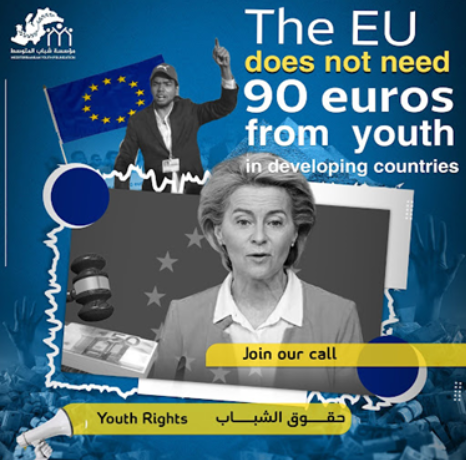
Streamlining Schengen Visa Processes: Towards a More Efficient Visa Acquisition Process for Greater International Mobility
- emphasizes the urgent need for the European Union to reform the Schengen visa acquisition process, particularly for Southern Mediterranean countries, to enhance efficiency and accessibility. The Mediterranean Youth Foundation for Development (MYF) advocates for economically advantageous practices and the establishment of a communicative network among developing Mediterranean nations to foster international mobility.
- A significant concern raised is the high visa fees that create financial barriers for young applicants in Southern Mediterranean countries. The current fee is 90 EUR, which, combined with additional service management fees and potential bribes to secure appointments, leads to expenses greatly exceeding the cost faced by European applicants. For instance, applicants from Southern Mediterranean regions may incur total costs of 2,500 to 3,000 EUR due to various hidden fees, while European applicants often pay just 25 USD or enjoy visa-free entry to certain countries. Such disparities not only limit personal and professional opportunities but also raise issues regarding the violation of the right to freedom of movement, as stated in Article 13 of the Universal Declaration of Human Rights. The additional reliance on third-party visa service providers also raises concerns about transparency and potential corruption.
- Furthermore, the paper highlights the challenges posed by securing appointment slots for visas through intermediaries, which have been known to manipulate online booking systems. This practice complicates the application process and imposes further financial burdens on applicants, as slots can be resold at inflated prices. The authors call upon Schengen Area governments to collaborate with visa departments and outsourcing companies to protect individual applicants and ensure a fair appointment system.
- The document also details the bureaucratic complexities and high rejection rates of Schengen visa applications, particularly highlighting that in 2022, African applicants faced a rejection rate of 30%, which starkly contrasts with the considerably lower rates experienced by applicants from Western countries. The lack of transparency and convoluted bureaucracy further disadvantages applicants from Southern Mediterranean nations, prolonging their visa acquisition journey.
- MYF posits that adopting a streamlined visa process akin to Germany’s exemplary model could alleviate these issues, where clear and accessible visa policies promote greater international exchanges and facilitate mobility for students and professionals. The role of the EU is highlighted as critical in transforming migration patterns, with a call for the reduction of discriminatory practices in the visa application process to support inclusivity and progress across regions. In conclusion, enhancing transparency, simplifying visa procedures, and fostering economic and social exchanges are paramount for achieving equitable international mobility and addressing development disparities.
- We propose a unified application mechanism to create an equal, transparent, and inclusive visa issuance system. This includes monitoring visa fee exemptions for students and NGO workers to enhance access to education and international collaboration. We highlight the importance of enforcing existing exemptions and employing digital technologies to ensure application status is transparent and accessible. Tighter regulations are needed to combat the monopolization of visa appointments by third parties, which creates unnecessary demand and inflates costs. These practices can lead to economic and social growth, promoting international mobility and development, and strengthening global connections. We encourage support for this initiative through signing our letter and spreading awareness
The Mediterranean Youth Foundation for Development – MYF strongly urges the European Union to adopt more efficient and economically advantageous practices for the Schengen visa acquisition process in Southern Mediterranean countries. We also invite other countries to adopt common practices to build a communicative network among developing countries in the Mediterranean area, ensuring broader international mobility.
High Visa Fees
- In Southern Mediterranean countries the high Schengen visa fee of 90 EUR, additional service management fees, and the often necessary bribes to secure an appointment create significant barriers for young people seeking international mobility. Applicants from Europe often pay significantly less, a mere 25 USD, or even enjoy visa-free entry to some countries like Morocco. In contrast, applicants in Southern Mediterranean countries often end up paying four times the official fee: once to the embassy, again to cover the service management fees (2500 – 3000 EUR), a third time to visa brokers to secure an appointment at the embassy (80 – 100 EUR), and a fourth time to prepare and translate the list of required documents (50 – 80 EUR). These costs represent a significant financial burden for applicants from Southern Mediterranean countries, where the average income is lower compared to European nations.
- This disparity in visa fees and procedures raises concerns about the potential violation of the right to freedom of movement, as enshrined in Article 13 of the Universal Declaration of Human Rights. The excessive costs imposed on applicants from Southern Mediterranean countries may disproportionately affect their ability to exercise this fundamental right, creating barriers to education, employment, and personal development opportunities abroad. Furthermore, the requirement to use third-party service providers raises questions about transparency, accountability, and corruption in the visa application process.
- Additionally, visa fees imposed on citizens of underdeveloped nations create an unjust barrier to travel; this system disproportionately affects those with fewer resources, hindering opportunities for cultural exchange, education, and business ventures. Instead of promoting a level playing field, these fees exacerbate existing inequalities and hinder the pursuit of social justice, limiting the ability of individuals from developing countries to participate in the global community, as well as deepening the development gap between the Southern Mediterranean countries and Europe.
Corruption and Appointment Challenges: The Hidden Costs of Securing Visas
- Securing appointments through intermediaries like BLS International and Almaviva is another significant challenge that exacerbates the disparity in access to visa appointments. For example, in certain EU countries, non-EU applicants must attend an in-person appointment at the embassy to obtain a visa. While these appointments can be booked online, it is extremely difficult to secure one due to the scarcity of available slots. This shortage is attributed to online intermediaries who, apparently using automated systems, occupy the slots as soon as they are released by embassies on their websites. These intermediaries then resell the captured appointment slots for higher prices. In contrast, visa appointments booked directly through the website of an embassy are generally free. This practice places an additional burden on applicants, who face unforeseen expenses and must navigate a complex system.
- Governments across the Schengen Area must recognize the risks associated with visa intermediaries and the potential damage to their reputation if an opaque group of intermediaries gains control over the online appointment booking system. To mitigate these risks, there is a growing need for coordinated actions between government visa departments and outsourcing companies to ensure the protection of individual visa applicants.
- Moreover, the reliance on intermediaries can create vulnerabilities that extend beyond financial burdens. The opaque nature of the appointment system can potentially be exploited for political purposes, allowing governments to manipulate visa issuance based on factors unrelated to merit or eligibility. Such practices can undermine the principles of fair and equitable treatment, erode public trust in government institutions, and create diplomatic tensions.
Bureaucratic Complexity and High Rejection Rates
- In 2022, the absolute number of Schengen visa applications in Africa decreased by almost 7.7%. Nevertheless, despite the significant decline in the percentage of Schengen visa applications, the rejection rate increased significantly in Africa, reaching 30% over the same period, a 12% increase from the 18% rejection rate in 2014, and nearly twice the global average. About three in ten African Schengen visa applicants were rejected, compared to one in ten applicants worldwide. Africa accounted for seven of the top ten countries with the highest Schengen visa rejection rates in 2022: Algeria (45.8%), Guinea-Bissau (45.2%), Nigeria (45.1%), Ghana (43.6%), Senegal (41.6%), Guinea (40.6%), and Mali (39.9%). By contrast, only one in twenty-five applicants residing in the US, Canada, or the UK were rejected, and one in ten from Russia. Despite justifications based on security or economic concerns, the European visa system demonstrates apparent bias against African applicants.
- Bureaucracy further disadvantages Southern Mediterranean populations. Similar to Egypt, the visa issuance procedures in other Arab countries like Morocco and Tunisia are characterized by a lack of transparency and bureaucratic complexity. These unclear processes
- hinder individuals from moving, with applicants often facing a lengthy and convoluted journey to gather and submit the required documents.
- MYF aims to raise awareness among authorities about the benefits of a more efficient and accessible system, inspired by the German model, which represents an exemplary model of how efficient and transparent management can facilitate international mobility. This country has implemented a clear, accessible visa issuance system supported by a series of facilitations and economic exemptions, especially for school, university, and postgraduate students. These policies, combined with a well-organized visa issuance system, not only reduce economic and bureaucratic barriers but also promote a broader and more inclusive international exchange, fundamental for the economic and social progress of the country.
- The European Union continues to play a central role in migration patterns in the region. To promote fair and equal opportunities for legal mobility between Africa and Europe, the European Union must address these discriminatory practices within its visa application process. Governments should soften visa requirements to leverage the potential of different forms of mobility across the region. According to the UfM’s 2021 progress report, enhancing transparency and simplifying visa acquisition procedures are essential to promoting inclusive mobility, supporting personal and professional development, and driving overall progress.
We propose a shared application mechanism to ensure an equal, transparent and inclusive visa issuance system:
- Develop a unified mechanism that monitors and ensures the visa fee exemption of school, university, and postgraduate students. These exemptions significantly reduce economic barriers and allow for more equitable access to international education and cultural exchange. Although these exemptions already exist in certain countries like Austria, which allows visa free entry for students, it is necessary to ensure they are effectively enforced, as inconsistencies in Austria’s implementation have highlighted potential challenges in achieving widespread compliance.
- Implement exemptions for workers of non-governmental organizations (NGOs), exempting them from paying the visa fee. These exemptions significantly reduce economic barriers and allow for more equitable access to international collaboration and community service. Given that NGOs are community-serving entities funded independently through donations and grants, it is essential to ensure these exemptions are effectively enforced.
- We propose implementing practices that ensure transparency through the use of digital technologies, such as online platforms, allowing applicants to monitor the status of their visa applications in real-time. Furthermore, theregular publication of detailed guidelines and updates on visa issuance procedures will help keep the process clear and understandable, improving accessibility and reducing opportunities for corruption.
- To ensure a fair and transparent system, we needtighter regulations. These regulations should address the monopolization of visa appointments by third parties, who profit by creating unnecessary demand and inflating costs for legitimate travelers. Such practices may infringe upon the rights of individuals to equal access to government services and could constitute unfair competition.
- We emphasize the importance of adopting these regulatory practices as they offer significant opportunities for economic and social growth. By simplifying and clarifying the visa application process, we can promote greater international mobility as well as greater innovation and development within host countries. The adoption of these practices can yield long-term benefits, strengthening the socio-economic fabric of nations and contributing to a more connected world. Promoting a shared vision of mobility as a driver of economic and social development is crucial.
How can you help?
- Sign the letter found here!
- Spread the word! Share this statement and let your network know about our initiative.
- Stay tuned! We’ll keep you updated on our progres.
project includes:
Project Status
Completed
Countries covered
4
Start date
31-05-2025
End date
30-05-2027
Programme
Erasmus+
Key Action
Learning Mobility of Individuals
Action Type
Mobility of young people